Why We’re Working to Establish Complex Neuro-Connective Tissue Conditions Awareness Month
This is from our founder, Amy Wang-Hiller’s LinkedIn article:
When I first shared what our nonprofit was about and whom we serve, someone commented that conditions like cancer would always get more attention than communities like ours.
I kept thinking about that. And I kept working.
June already recognizes Alzheimer's and Brain Awareness, Migraine and Headache Awareness, and Scoliosis Awareness. But there is nothing for patients whose conditions fall at the intersection of connective tissue disorders and serious neurological injury – conditions like craniocervical instability (CCI), atlantoaxial instability (AAI), brainstem compression, and tethered spinal cord.
When left undiagnosed, these conditions can progress to severe and irreversible neurological injury. I know this firsthand – I became quadriplegic after years of delayed diagnosis. That is why I founded InclusiVibe Foundation.
Research documents an average diagnostic delay of more than 14 years for individuals with rare and complex conditions (EURORDIS, 2009). In one study, 94.4% of patients with hypermobile EDS reported having received a psychiatric misdiagnosis prior to their EDS diagnosis (Lee & Chopra, 2025). Chronic brainstem compression from craniocervical instability remains under-researched and underrecognized compared to acute brainstem injury from stroke or trauma (Henderson et al., 2024).
Patients with brainstem compression may be told they have refractory migraine without investigation for structural causes. Patients with tethered cord may be told it's just scoliosis without imaging that would reveal the tethering. Patients with autonomic dysfunction may be labeled with anxiety without testing for conditions like POTS. Meanwhile, the surgeries they need – craniocervical fusion and decompression – are classified as experimental by insurance. For many of these patients, there is no established care pathway.
"Complex Neuro-Connective Tissue Conditions" is an advocacy and awareness term we use at InclusiVibe Foundation to describe overlapping neurological, connective tissue, autonomic, spinal, and multisystem conditions that significantly affect daily functioning, mobility, and access to care. It is not a formal medical diagnosis or clinical classification. We created it because nothing else names what this population actually lives with.
We recently submitted a proclamation request to the Denton County Commissioners Court in Texas to designate June 2026 as Complex Neuro-Connective Tissue Conditions Awareness Month. And we built a free Proclamation Toolkit so that anyone – in any city, county, or country – can bring this to their own local government.
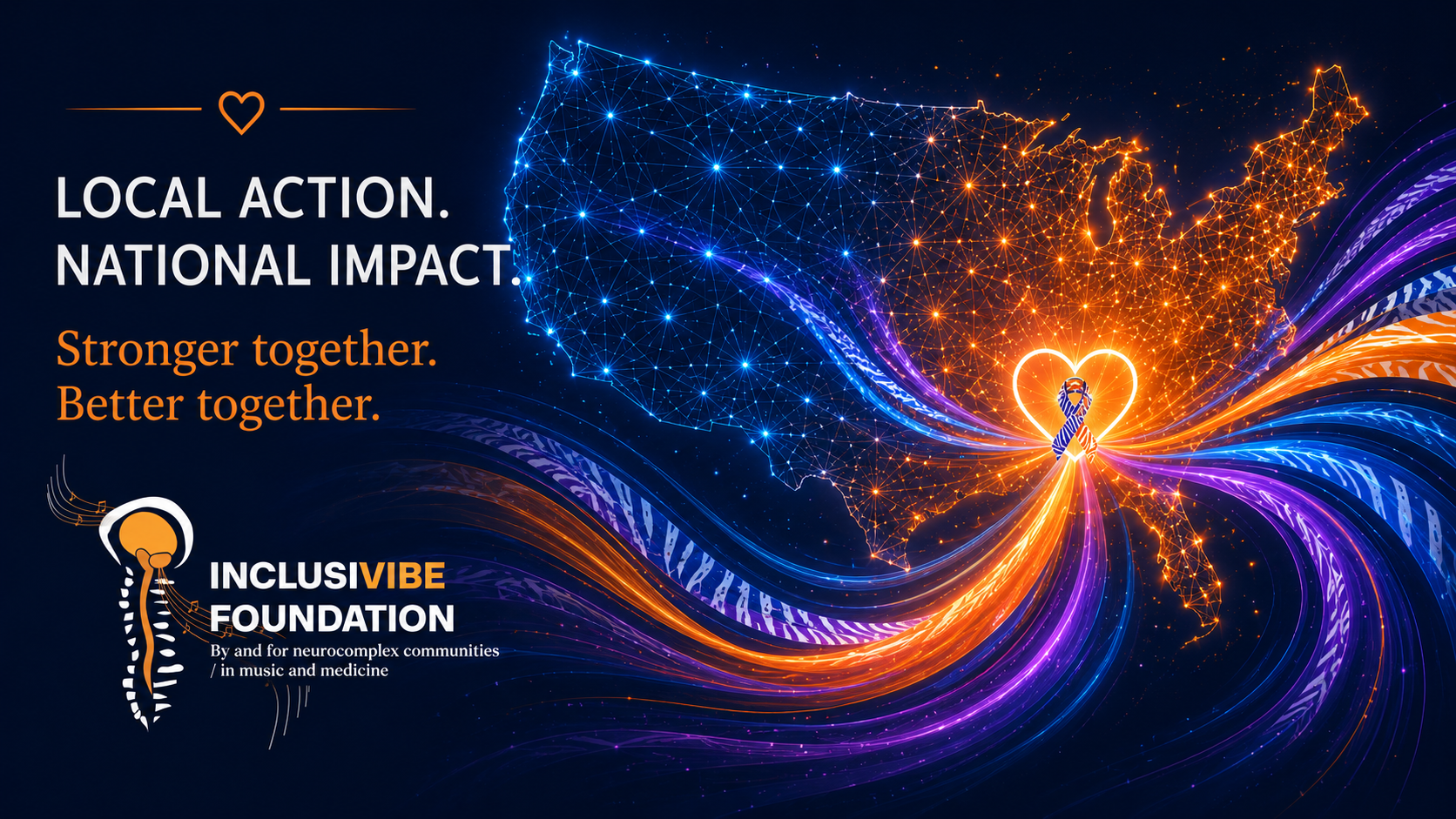
LOCAL ACTION. NATIONAL IMPACT.
CALL YOUR LOCAL CITY, COUNTY COMMISSIONERS COURT, WE OFFER YOU A FREE PROCLAMATION TOOLKIT WITH STEP-BY-STEP INSTRUCTIONS.
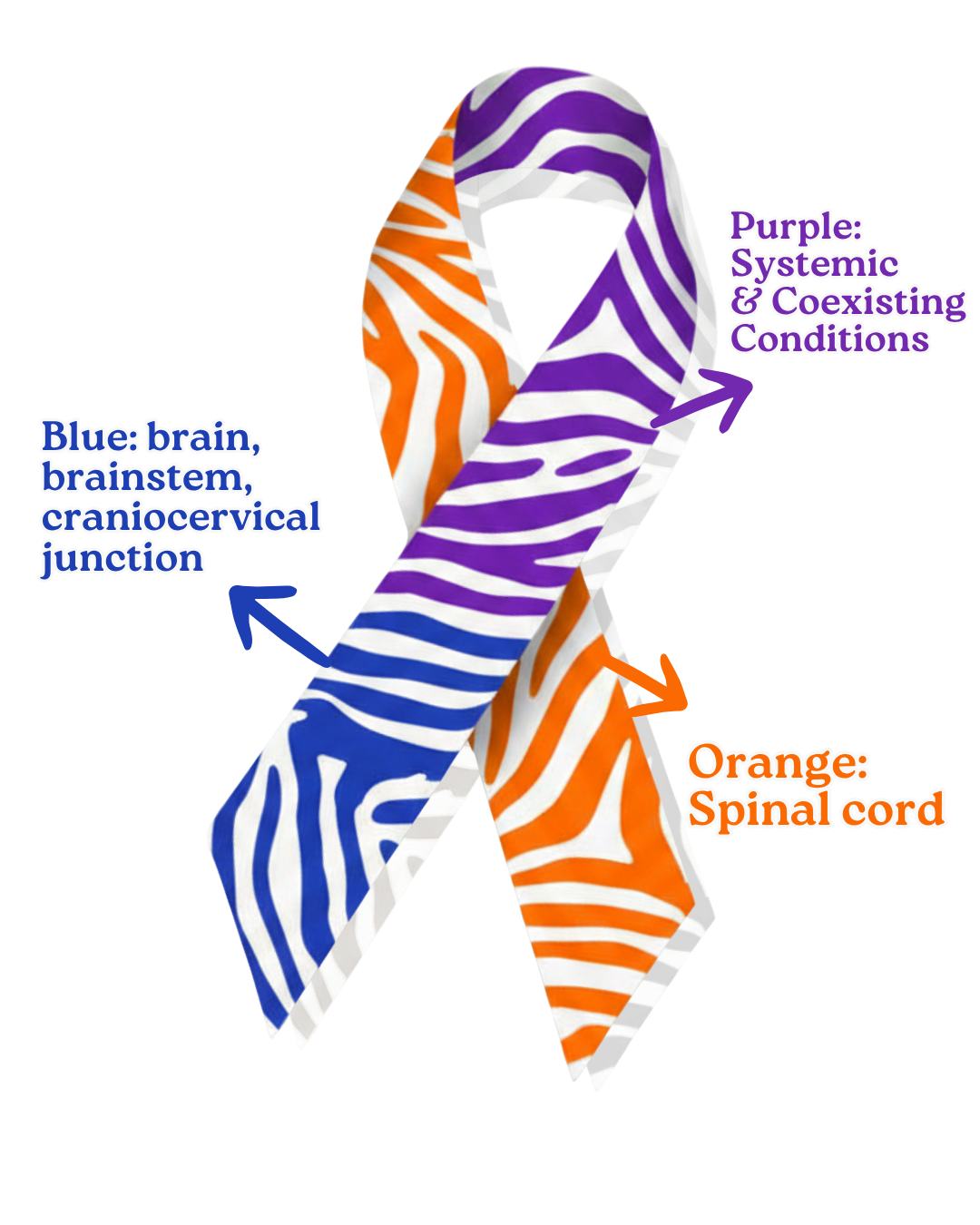
OUR RIBBON
And we developed the blue, orange, and purple zebra-stripe ribbon, which represents the daily overlap conditions these patients navigate.
Three different styles ribbons: tri-color zebra stripe ribbon for Complex Neuro-Connective Tissue Conditions
💙 Blue – neurological / brain and brainstem
🧡 Orange – spinal cord conditions / tethering
💜 Purple – multisystem overlap and coexisting conditions
If you are an artist, musician, healthcare professional, advocate, patient, caregiver, or ally – join us. Record a performance. Share your story. Download the toolkit. Tag @inclusivibefoundation.
We believe music and narrative art can improve clinical empathy . The system may be broken, but providers with empathy carry better patient outcomes. We are building the evidence for that.
Download the free Proclamation Toolkit: inclusivibe.org/awareness-month
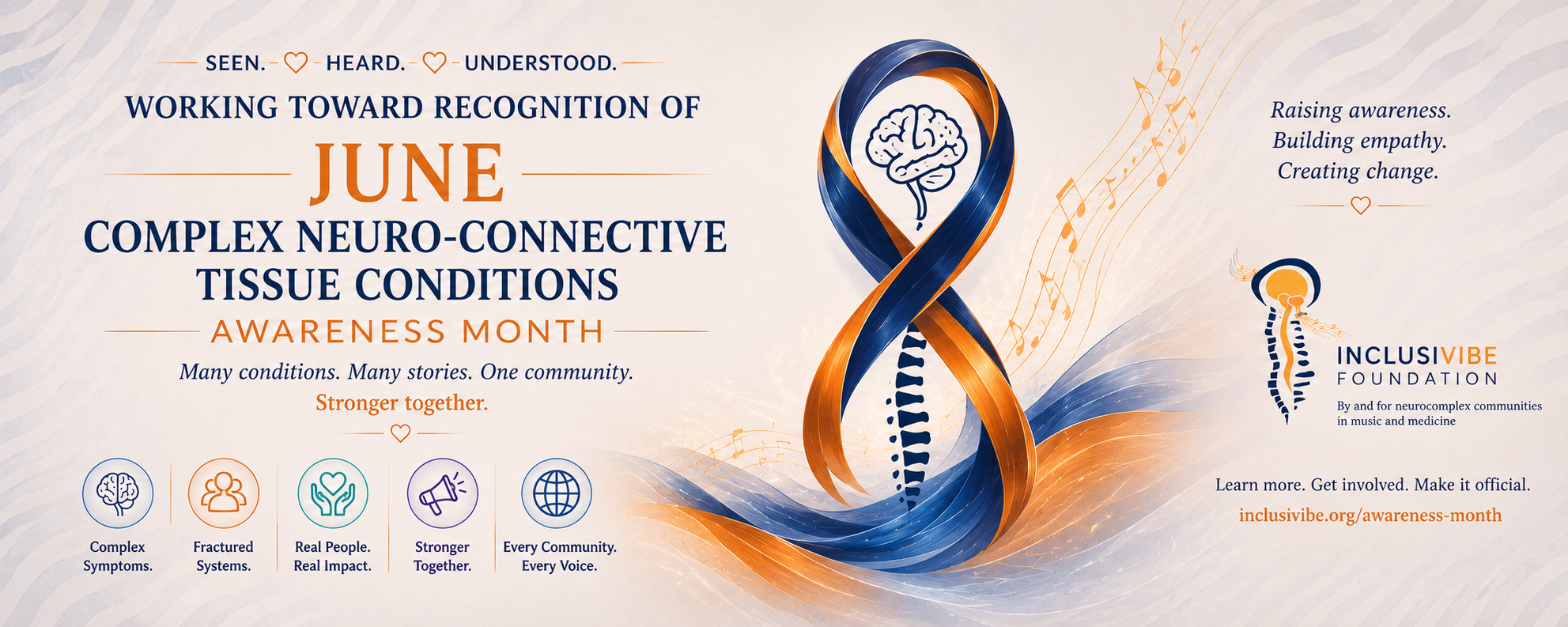
We understand that we are complex. We understand how difficult it is to diagnose and treat, but we need more education and awareness in our community, followed by belief from family members and physicians.