The Endless Days Get A Light at the End of the Tunnel; My Medical Journey Until Now
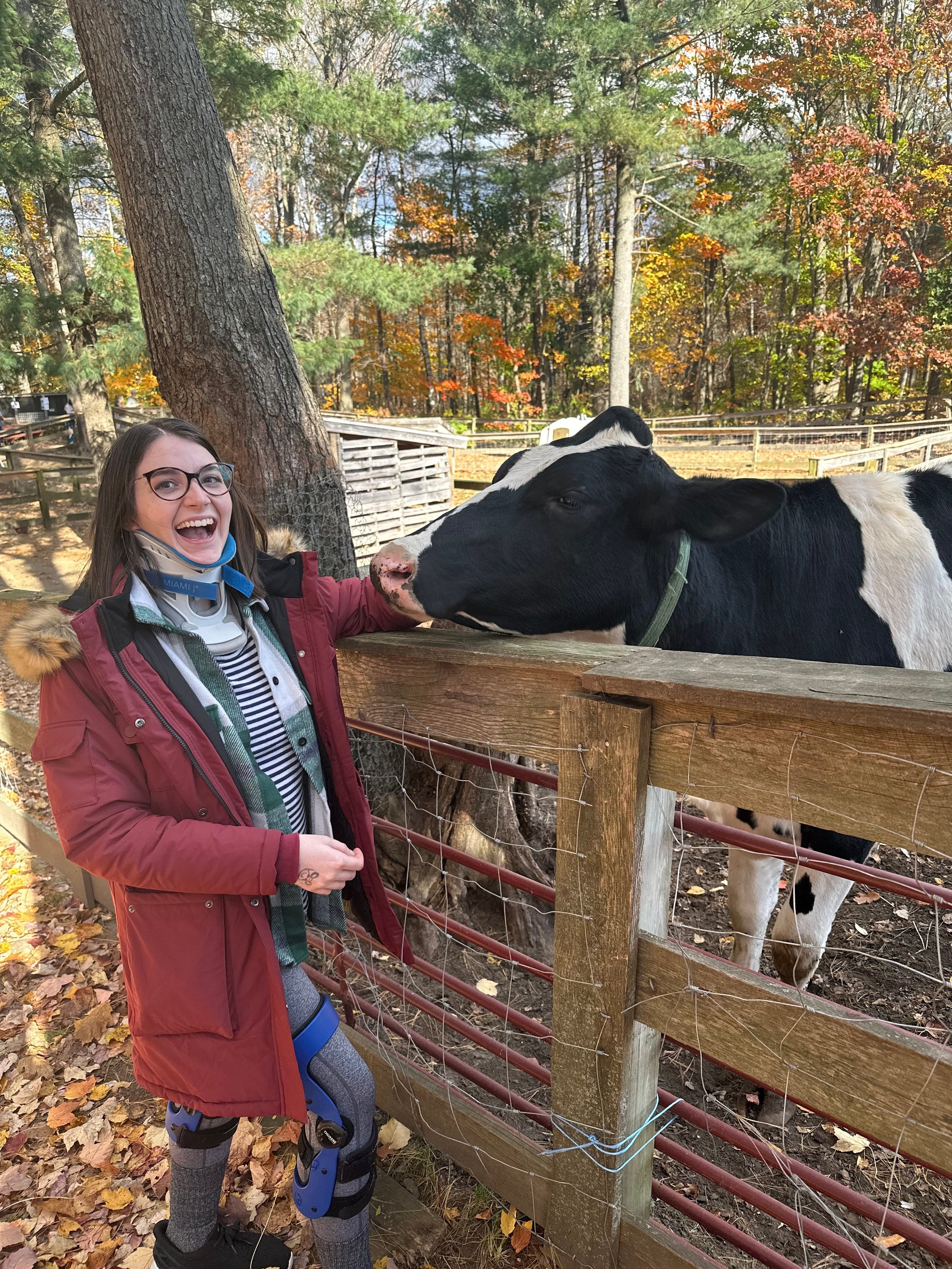
On a good day now I have 8ish active hours, broken up with many lay down breaks and naps. 4 of those good upright hours are in a rigid neck brace, usually in the early morning, a couple for work (from home on reduced responsibility), and a couple more for physical therapy every day. I do also take my dog on a very short walk on okay days, which is only possible because she is very responsive to verbal cues, including careful timing so that it is not a full bathroom trip, and she has been trained not to pull, so that it is safe for me.
The other hours are extremely limited to very minimal physical and cognitive activity, usually for nutrition/hydration/hygiene that has been adapted to fit spinal precautions and be simplified so that it is even possible. Sometimes these activities are accomplished laying down or I need help with. I do also film/post content semi-regularly as this is relatively low effort (although still time limited), helps with isolation, is extremely helpful in processing the things going on, and I find it meaningful in raising awareness. On weekends I may be able to do some light cooking, video games, art, or advocacy work within the two hours I use for work.
The rest of my days are in bed in a dim quiet room, usually asleep. If I overdo it, either by doing too much, or by unexpected illness or challenges (which can include something as small as stressful current events/confusing cognitive asks/emotional conversations/storms/changes in weather), I crash even harder; becoming confined to a quiet dark room and bed for the entire day, often unable to wear clothes due to allodynia, and cannot do any of my usual tasks, requiring significant help to accomplish even the most basic activities of daily living. I often also struggle with hydration/nutrition as my GI issues are exacerbated by these crashes, leaving me nauseous and painfully distended.
This article alone has taken over two weeks to write, although I acknowledge it is very long and emotionally charged
I have had a symptom load that most physicians did not believe until objective evidence on imaging and diagnostic tests finally showed what was wrong, and some are even skeptical enough to refute the objective evidence, claim it is faulty, and that I or the ordering physicians somehow manipulated them (we are talking things like repeated blood work and gastric emptying studies/ repeated imaging). I was however, blessed to have a core team that was compassionate and comprehensive, despite ill-informed physicians claiming it was psychosomatic/functional neurologic disorder (FND), that still listened to their patient and did what was needed, including advising me to seek out specialists that were actually knowledgeable. Many of those compassionate doctors expressed that even they had a significant amount of skepticism, understandably due to the complexity that is, until my labs/images came back with clear, undeniable results. I would be lying if I said that I didn’t question myself. Especially as I have a diagnosis of PTSD, I did understand where the thought was coming from.
The core team of my primary care physician, allergist/gastrointestinal specialist (GI), occupational therapist, and physical therapist continue to be instrumental in managing my care and advocating for my needs, especially as I have sought research specialists’ evaluation for rare and complex conditions that other physicians refused or were not able to work up or treat. They have also helped me to manage the misdiagnoses from unequipped ‘specialists’, including in acute ER events, and to explain to new providers what is presently happening with my case. They have also been the quarterback for getting me to these specialist researchers, ordering the preliminary imaging and making referrals, as well as collaborating with them on executing my care plan.
I am in constant pain of varying quality and intensity and have been since as long as I can remember. I have never had true full relief, even with medication, including IV analgesic, so it was decided initially to be largely psychosomatic. Vision and hearing disturbances, including blurriness/snow/double vision/vertigo/sensitivity to light&sound/tinnitus/hearing loss, as well as temperature sensitivity, easy bruising, tremors, extreme fatigue, and sensory impairment had previously been attributed to atypical-non-responsive-migraines or damage from being a competitive shooter in my youth/lead poisoning, if not also psychosomatic. Proprioception challenges were brushed off as just being clumsy. Excessive salivation with hives and pain upon eating was dismissed as hypervigilance, frequent UTIs and pelvic/abdominal/back pain brushed off as normal for women my age or “just endometriosis”, sensation differences/tingling/numbness were blamed again on me “thinking too much about my body”, neck pain and radiculopathy categorized as a normal case of bad posture or hypervigilance again from “being born in Kentucky” (that was really a pain management doctor’s actual diagnosis).
As you may have noticed, I had many of my symptoms incorrectly attributed to hypervigilance, which stems from Post Traumatic Stress Disorder (PTSD) as I do also have a diagnosis of that. I received successful treatment for my PTSD, both with psychedelic medication therapy and integration talk therapy, which resulted in me no longer meeting clinical criteria in 2022, however all of my physical symptoms listed before remained, including flushing with hives that had been previously considered “stress rashes” from PTSD. I had trialed every migraine treatment option out there starting in my teens, and was entirely non-responsive. I also had no signs of lead poisoning or true vision/hearing damage on labs/tests. No provider was willing to investigate the endometriosis further than placing me on a hormonal birth control to manage symptoms.
It took just under a year after being discharged by my psychiatrist in 2023, after maintaining the improvement and still not meeting clinical criteria for PTSD any longer, for me to find the biggest answer to why all of these confusing symptoms were happening. That included many diagnostic tests; tilt table test, mast cell blood work, supine MRI, supine CT, flex/ex X-rays, MRA/MRV, neuropthamaology evaluation, and finally comprehensive genetic testing with gastric emptying study and specialized spine imaging to follow.
Some of my symptoms, like joint pain from frequent subluxations/dislocations and fragile tissue, are from hypermobile Ehlers-danlos syndrome (hEDS), and some are from common comorbidities; like the syncope from Postural Orthostatic Tachycardia Syndrome (POTS), hives/inflammation/pain from Mast Cell Activation Disorder (MCAD), or the bloating/nausea/pain/constipation from gastroparesis.
These conditions were diagnosed out of typical order, as my doctor had initially considered lead poisoning, so the tilt table test was the first one ordered, and POTS subsequently diagnosed. This, combined with negative blood tests for lead, tipped my PCP off that there had to be another systemic cause. She had other patients with these conditions, so she thought to run me through the clinical diagnostic criteria for hEDS and then stopped short of an official diagnosis, as I had not had auto-immune conditions ruled out, or other connective tissue disorders with signs that overlapped due to limb proportions/arachnodactyly.
This would begin a long process of visiting many specialists, most of whom had no clue what to do with me. The rheumatologist I was sent to brought in the other staff to show a “textbook case of connective tissue disorder” and then informed me that I had no auto-immune signs and that I would ultimately need the genetic testing to confirm which connective tissue disorder I had, again due to the overlapping presentation. Rheumatology is not where you go to get diagnosed with a connective tissue disorder, which is a huge misunderstanding, I think due to the requirement to have alternative rheumatologic conditions ruled out prior to receiving a diagnosis of hEDS. hEDS remains a diagnosis of exclusion based on clinical presentation and history without a clear marker to test for, so ruling out similar conditions that can be tested for is crucial in the proper diagnosis and following treatment. This rheumatologist had a packet to help me while I waited, but almost all of it, other than the need to start PT, was incorrect. They had told me things like I could never lift more than 4 lbs or take the stairs ever again!
During this work-up, my neck issues got worse, most likely thought due to an injury acquired in my sleep, and so we began to work that up with the appropriate scans, and subsequent referrals to orthopedic surgeons and pain management specialists after the imaging reports showed issues like disc herniation and retrolisthesis/anterolisthesis that had translational movement from flexion to extension. I only had a working theory that there was some type of connective tissue disorder (CTD) happening at this time, which made it difficult to advocate for myself at the appointments, especially as they had no clue what that even meant or that there could be spinal manifestations of CTD. I was told repeatedly that it was “just hypermobility from the CTD” and that PT should help relieve symptoms, but there was no reason to worry. I had a severe worsening of my condition in November 2023, after lifting a large glass bottle at work, and suddenly could not sit upright without vomiting and syncope.
I saw a neurosurgeon shortly before the geneticist in December 2023, and I truly thank that man even though he could not help me and did technically diagnose me with FND. I had asked for the measurements that I had read were being used to assess connective tissue disorder patients in research, and he let me know that they would not perform those as they were experimental, and no one in Boston would dare touch it. He informed me that he had considered working for the NHS as a skull base specialist and was familiar with the controversy, but at the moment the research was not finalized enough to become standardized care. He shared with me the name of my current neurosurgeon, the researcher who he said he was thankful for that was trying to help patients like me and figure out what was happening and how to treat us. He let me know that with the tools available to him that there was no clear sign of damage, so he would be diagnosing me with FND and hoped that simply with bed rest I would improve, but let us know that the researcher was accepting patients and it may be worth a consultation if I did not improve.
At this point, I had lost my first PCP as she moved home, and I was struggling to find a care team that would actually listen and help. Many of the providers I tried to consult simply wrote off my issues as psychosomatic and even tried to prescribe psychiatric medications, that had been previously refused by my actual psychiatrist, sometimes without telling me and proposing the medication as a different kind.
I would see the geneticist just weeks after the neurosurgeon, where he was able to do a full clinical assessment, order the appropriate genetic tests, and ultimately diagnosed me with hEDS and suggested that MCAD and gastroparesis were likely complications I should get worked up further. We also discussed my spinal issues and he advised to avoid fusion at all costs unless it was absolutely the last resort. He was wary of the “EDS surgeons”, which I would come to learn more about later.
My allergist/GI ordered the appropriate tests per my geneticist’s request and shocker! They came back positive for MCAD and gastroparesis. I was started on medication and lifestyle changes to manage my symptoms, which has been up and down, but so much better than when untreated. It is suspected that my spine issues are worsening these conditions.
I finally found my current PCP and explained my situation and that I had sent my packet to the out of state specialist neurosurgeon mentioned by the Boston neurosurgeon, but the wait was long so I had also made a plan to try another neurosurgeon familiar with the researchers that had a shorter waitlist, this time in Maryland.
The Maryland neurosurgeon was instrumental in getting me on the right path of treatment. He immediately recognized my postural symptoms as likely a cerebrospinal fluid (CSF) leak, acknowledged general instability was present from the very first dynamic scans, ordered more detailed and specific dynamic tests (upright flexion/extension MRI and rotational CT), and explained that the signs of stretch injury/degenerative disease paired with the head/spinal trauma I have gone through in the setting of hEDS likely would result in eventual fusion, his best guess was skull to pelvis. He pointed out that specifically being carried/dangled by my head had clearly caused issues throughout my spine, including perineural cysts almost uniformly bilaterally throughout the entire spine. In his opinion, while the neck brace was working and I was able to do PT, he would personally defer fusion as the risk of end segment disease is tremendously high in CTD patients. He also explained a leak likely caused greater severity in symptoms from instability due to the brain sagging, so he hoped after patching that we could put it off even longer and have improvements in quality of life.
I found an interventional radiologist familiar with EDS and CSF leaks, who was in Boston all along! He was able to see some indirect signs of a leak on imaging, and we chose to do a diagnostic high volume multilevel blind blood patch, due to the risk of a bigger leak from a lumbar puncture or myelogram. He suspected I was a long term leaker since the onset of my “migraines”, secondary from the spinal instability, and had a spiky-leaky presentation, where there was likely some cause of intracranial hypertension that was then causing leaks, but had also blown a larger more serious leak after lifting that heavy 10L glass diluent bottle at work. I had my blood patch February 2024 and instantly was able to sit up, had much less severe nausea and POTS. I even went back to work for a short time. I would continue recovering for a few months with many improvements, going back to maryland after being released from strict spinal precautions of no bending/lifting/twisting to have the specialized dynamic imaging performed. This would again confirm the instability.
I had finally received my initial report from the specialist researcher neurosurgeon, who did suspect CCI and another condition called Eagle’s syndrome, and occult tethered cord syndrome with positive radiological yamada criteria.
I soon started being unable to lengthen my right leg and having urinary/bowel incontinence. This ultimately would take me back out of work.
I had discussed the possibility of tethered cord syndrome with the Maryland surgeon before, but did not have a classical presentation on imaging and we discussed researchers working on the possibility of an occult variant, meaning it wasn’t present on imaging.
I had put this on the backburner as my symptoms didn’t line up perfectly, that is until PT couldn’t help my spasm locked leg or urinary/bowel incontinence and my team became concerned. I sent my information over to another one of the researchers with a shorter wait and larger insurance network, and she diagnosed me with tethered cord syndrome (TCS), and while atypical presentation, it was visible on imaging due to a lumbosacral transitional vertebrae changing the kinetics of my spine. This would be further confirmed by the pathology lab after my filum terminale was sectioned/released, which is the surgical treatment of this condition. The hope was to release tension on my unstable spine, stop the stretch injury, relieve those symptoms, restore function, and to relieve some of those instability symptoms as well. None of these were guaranteed. She suspected that the mechanical irritation of the blood patch caused a preexisting condition that was likely present from birth, due to long history of toe-walking/UTIs/altered sensation/pain, to worsen suddenly and cause the new symptoms of altered gait/incontinence.
I was working hard in PT, finally with a hEDS specialist familiar with spinal conditions, and massively improved in the aftermath of this surgery. This work was hard, exhausting, and at times, very painful. It was worth it as I was able to walk independently, regained strength and function, and was even able to go back to work full time and only wore a neck brace in vehicles/physical activity for many months.
I would eventually crash into what seemed like the worst summer flu of my life after a family vacation where I did entirely too much. My skin was burning, I had intolerance of light/sound, terrible brain fog, vertigo/proprioception issues, lost significant weight quickly, worsened POTS/MCAS that had previously been manageable, and was extremely nauseous again. My PCP knew this was no flu, he had other patients with the same symptoms, and immediately recognized it as ME/CFS, allodynia, and autonomic failure.
I was diagnosed with a condition called Myalgic Encephalomyelitis, more commonly known as Chronic Fatigue Syndrome (ME/CFS) that is the primary reason for my current functional capacity being so low, although there is no real objective testing to confirm this. The working hypothesis for my case is that due to spinal conditions damaging nerves (residual damage from CFS leak and TCS, as well as CCI) and post viral illness combined (EBV and Covid), I have developed this condition, which is hallmarked by post-exertional neuroimmune exhaustion, more simply described as post-exertional malaise. This condition is also interconnected with Mast Cell Activation Disorder (MCAD), dysautonomia, and gastroparesis as it often causes flares of these.
If I do anything more than the functional capacity described, including mental and emotional expenditure, I crash and it’s severity is commiserate to the energy spent. After my most recent major crash over the summer after a family trip to Maine, it required a silent, pitch black room for multiple days, and my functional hours were cut down to about 4hours of activity; with severe cognitive impairment, gastroparesis worsening, dysautonomia worsening, MCAD flares, and proprioceptive deficits that led to a fall. I have now worked for almost 6 months, including many smaller crashes along the way, to get back to a better baseline and be able to pace reliably enough to prevent more of these crashes. I have been reduced to 9 hours of work a week, on a strictly remote basis and reduced responsibilities.
The fall I had shortly after that crash, caused my symptoms of radiculopathy/pain/vision+hearing impairment/swallowing issues/brain fog/memory to worsen. This massively set me back in PT, and sent me back to the neurosurgeons. The Maryland surgeon said he had a firm surgery threshold for fusion of being entirely bedbound for two weeks without ability to tolerate light/sound. This was not acceptable to my care team, although I had honestly made peace with it. I begrudgingly sent off my updated packet back to the first research specialist knowing that his assessment required invasive imaging/testing procedures and had heard he offered fusion at a far lower threshold with too many malpractice cases for comfort.
It is kind of disappointing that even after so much work, care from the best team possible, and what I have been told is a miracle improvement by some of the best -and only- specialists that I am endlessly thankful for, that my capacity is still so tremendously limited. Nevertheless, after learning about what my fellow patients face? I do consider myself truly blessed and extremely lucky (with a large helping of many privileges).
Thankfully I had already sent my file to that EDS/CTD upper cervical research specialist surgeon in the past, had since talked to many patients and trusted EDS/CTD specialists, researched surgical techniques of the specialist surgeons, and felt most comfortable and confident in this surgeon as he was recommended by the tethered cord surgeon and my physical therapist. He does offer surgery before the extreme threshold of traditional surgeons, in my case the two weeks fully bed bound in silent darkness stated by the Maryland surgeon, but is still far more conservative and comprehensive in his work up than other EDS surgeons, at least in my experience and research. The malpractice cases would reveal a much more complicated environment, typically due to ancillary care/staff rather than true surgical issues, or in some cases due to poor surgical outcomes in severe/complex cases that I have been told by other specialists/CTD advocates that were being pushed by competing surgeons that those patients saw for second opinions in the aftermath of the failure. After meeting with him to discuss my case later, he was very transparent that this was experimental, risky, and a good outcome was not guaranteed, and it was imperative to only go through with surgery to prevent loss of limb/life/function, and that it was not a cure. He shared that some people do improve, and that is the hope, but the primary function is stabilizing the present condition.
He had preliminarily identified suspicions of craniocervical instability (CCI) and Eagles Syndrome (Elongated Styloids) and already had invited me for further diagnostic testing. I had initially deferred this testing, because of fear partly, but mostly because I had been doing so well. After crashing and getting the ME diagnosis, and talking with many specialists treating me and patients living with similar, it was clear that it was time to proceed.
I didn’t quite understand the connection at first, and honestly the research is quite new, but after learning how these conditions could quite literally death spiral, I took the leap of faith.
Every single voice doubting me echoed around as I waited on “proof”, and I secretly hoped that it was all wrong and maybe it was Lyme or mold and maybe there was a “cure”, a way to “heal”, a way to “detox”, maybe it was always just in my head and I was insane.
Over my 25 years, my father was my first nonbeliever. Telling me as a child that it was all normal, refusing to allow me to see doctors, claiming I was lazy or crazy, and blaming that (or bullying) for “migraine episodes” that left me in a dark quiet room for days in my teens. I missed so much school I was truant three times over and the school district demanded adequate medical documentation to excuse the absences, and even then, when I failed migraine treatment and the neurologist suggested I go to a Chiari specialist in NY because it seemed possible to her that is why my symptoms were atypical and non responsive, my father pulled me from her care and told me they were “quacks” and just wanted to rip us off. That specialist in NY would later become my surgeon, albeit for different conditions.
I didn’t have any other option but to grit my teeth and find a way through my younger years. I would be lying if I said I didn’t contemplate an easier way out in the past, and do have scars reminding me of how I am on borrowed time. State mandated therapy post my parents divorce and a lot of luck and privilege was literally what saved my life early on. In that early therapy we planned my escape and how to cope with the abuse/neglect. I did eventually make it to college, graduating high school early and forgetting all about NY. I barely scraped by between “migraine days” and careful class scheduling. I turned to self medication and partying at this point to numb myself to the suffering I had accepted as normal, which certainly didn’t help my grades. I did make it through by the grace of god (and university health trying their best with therapy/medication that didn’t quite work), and even found a more reliable ticket to true independence with a pathways internship placement as a park ranger, working for freedom from my father who maintained as much control as possible through emotional and financial abuse during college.
After college, I tried to clean up my act and without my (very unhealthy) coping mechanisms I fell apart and the damage they caused and masked was catching up with me. Finally going to the doctor on my own insurance, the only answer I had so far was PTSD, Migraines, and subsequently FND (although they would not officially call it that until later) for my racing heart, hives, sensory intolerance, exhaustion/malaise/nonresponsive “migraines”, so I did what any good patient would do and did everything possible to get better.
I failed so many meds, and others were contraindicated due to family history of bipolar. I tried every therapy modality, CBT, DBT, EFT, IFS, EMDR, doing group sessions, and learning newer experimental treatments like the stellate ganglion block and psychedelic therapy. I was not a candidate for the block as my trauma was so complex and the provider I consulted said it was most effective for single event traumas. I was a candidate for a psychedelic program however, and underwent a 6 month program in 2022 while on leave with regular integration therapy sessions and group sessions. I miraculously went from an extremely high score on the PCL-5 to no longer meeting clinical criteria for PTSD. Now, that is not accepted by most providers so I still carry that diagnosis and there are differences I also still carry, but they are not presently distressing or limiting and I have not had flashbacks, night terrors, or panic attacks due to triggers since. My psychiatrist followed me for a year while I went back to work and then discharged me because I was stable and no longer needed help from his speciality in his opinion. I also took a brief step back from talk therapy, mostly due to loss of insurance during contract employment, but have since added it back in after being insured again and receiving the first diagnosis of dysautonomia, since FND was then suggested as a cause, specifically due to my history of trauma. This has since developed into support therapy for my chronic illness, as it was clear that trauma was not causing the physical symptoms I was left experiencing after improvement in PTSD. The dysautonomia and hives were not tied to any psychological symptoms or presentation. I continued to have “migraines” that were non responsive to psychological treatment and it was suggested that I seek a full physical work up by other physicians, now by both my old psychiatrist and new therapist. Therapy has transformed to present day being more of a verbal processing approach to support the toll of being chronically ill, rather than any single therapy modality due to my current condition.
As mentioned earlier, I was diagnosed with hypermobile ehlers danlos syndrome (hEDS). My geneticist suspected my father who had normalized all of the features of the condition, namely pain and fatigue, and who was highly dependent on NSAIDs, B12 injections, and laxatives/fiber was who I inherited it from. He was also an alcoholic, which can be common in those attempting to self medicate. This determination was based off of my memory/observation of his behavior rather than a direct interview, as we are estranged due to his abuse. The puzzle pieces had slowly started to come together by that time.
After much research and talking to other trusted providers and patients as I have pointed out, it was obvious the universe was practically shoving me towards NY. I am thankful the timing worked out instead of my fight to avoid surgery being wasted, mainly due to trying conservative management like PT/bracing in the meantime, but all signs still ended up pointing right back to NY. As I worked in PT and got reports from the further specialized imaging, it became apparent that my issues were more vertical and upper cervical in nature. The only surgeon, to my awareness, that tests for vertical instability specifically with a “dress rehearsal” of sorts for determining where the vertical positioning of fusion needs to be, is the one in NY. The other surgeon I consulted kept kicking it back to CTD specialists and was clear that fusing by him would be an extremely risky last resort due to widespread instability and likely would result in further deterioration, which is why they projected it resulting in a skull to pelvis fusion, if I made it that long. He told me the EDS surgeons would likely do it sooner, but had mixed results.
In hopes to only need a short fusion and prevent further decline, I found myself in NY. The surgeon that was always mentioned by the other surgeons/neurologists/PTs/regenerative medicine providers over the years as my only real alternative to PT/spinal precautions/bracing.
I desperately wanted to try regenerative medicine but was told over and over, by the regenerative folks themselves at times, that my severity wouldn’t likely respond well and I should get a neurosurgeon’s clearance before attempting to move forward with that, and even if I could, it would be a regular maintenance procedure for the foreseeable future due to the etiology of my condition being from hEDS.
I had researched every single EDS/CTD specialized neurosurgeon offering craniocervical fusions, but most remained focused on horizontal and rotational instability, rather than vertical. I learned about the methods and measurements to the best of my ability to understand why this NY surgeon was so special. I also had picked apart every malpractice case I could as mentioned and talked to countless of his patients. (If you spoke with me, you are part of my healing journey and I thank you deeply.) I am also happy to discuss this with other patients, but in short, things can and do go wrong, but he is still a capable and caring physician and I trust him fully with my case now. He is quite literally discovering how these conditions present and how they are best managed, while improving his practice every single day. He is the only real option for treating this condition before it becomes more severe with probable permanent damage, yet it is still experimental.
I was still nervous as I traveled to NY for the invasive testing. Meeting a surgeon who is going to drill holes into your skull just to give you a diagnosis is daunting, but I at least now knew I had tried everything else and I was in the best hands.
The process is long and slow, as he is truly the only surgeon doing this specific approach in the US, and one of very few globally. Due to the severity of this condition, and the importance of timely intervention, he does also prioritize severe and urgent cases which can extend the duration of waiting for some patients, especially for those able to do PT and remain somewhat functional like myself. Once I was ready to move forward, I had become severe enough that the timeline for revaluation shrank from what I experienced waiting for the initial consult. The length of the process then became limited by his and other specialists that collaborated on his team’s availability, insurance approvals, and finances.
October 2nd 2025 I had invasive cervical traction, specialized MRI/CTs and intracranial pressure bolt monitoring.
November 13th 2025 I had a cerebral angiogram with venous manometry.
Both testing periods were rough, but mostly due to the travel required, the need to provoke symptoms for testing, and lack of accommodating furniture in hotels.
November 21st 2025 I got my official confirmed diagnoses and surgical plan.
I indeed have vertical craniocervical instability (CCI) and met surgical criteria in radiographic morphometrics, clinical response to the invasive traction, and responsive neurological examination improvement. I also had been worked up for suspected vascular involvement and Eagle’s syndrome from an elongated styloid. With a positive glossopharyngeal nerve block combined with CTA/ Cerebro angiogram, I had confirmed bilateral eagle’s syndrome, with more nerve involvement than vasculature, more on the right than left, although there was both for both sides.
These conditions will need to be treated in three surgeries, an occipital cervical fusion and two styloidectomies, that will need to happen a few months apart to allow for adequate healing for safe recovery. Insurance typically takes a few months to approve the pre-authorization as well. The next year and a half, or so, will likely be painful and hard, but it will bring at minimum stability and hope for freedom from some of the most debilitating symptoms I live with.
There is hope and a hypothesis that the ME, is at least partially, caused by the brainstem injury in my case, and will be stabilized, or hopefully improve after fusion.
There is also hope that with improvement from fusion, that I may be able to live with Eagles and avoid further surgery, although the chances are slim.
Despite such severe conditions and massive surgeries, no pain management doctor will dare take on my case, especially knowing the degree of medication that is indicated. This is primarily due to current DEA initiatives to end addiction and continue the war on drugs. Every physician I have seen has agreed I meet criteria, yet their hands are tied for prescribing what I would need in their opinion. The surgeon does prescribe for the immediate acute postoperative period, as he should, but due to being out of state, and current policies and regulations, it is only possible to be carried for a fraction of the actual recovery period. He asks that primary care or pain management carries the rest, but no one so far can/will assist. I am still looking for help here, but most likely I will be going forward without adequate pain management, in order to save what is left of my functional capacity. The pain of a skull to spine fusion and bilateral styloidectomies pale in comparison to that of very severe ME, at least to me.
These surgeries are not a magical cure, and likely there is some degree of damage that will be lasting, and there is always the potential for complications ir failure, but I have a light at the end of a very dark narrow tunnel for the first time ever. At the very least, I have an explanation for my suffering and the best physicians on my case.
Republished with permission, published originally Dec 5, 2025, on Substack: https://substack.com/home/post/p-180802911